Dating After Divorce: What Really Works Over 50
April 30, 2026
If you've been staring at your divorce papers, wondering whether your window for love has closed, I have someone I want you to meet.
I recently sat down with Lauren Handel Zander. She's the creator of the Handel Method, my former boss, my mentor, and the woman whose framework forms the backbone of everything I teach as a dating coach.
She also got divorced at 52 after a 25-year marriage, which she never saw coming apart.
And she found her person.
The good news? She did it with a plan. Not luck, not a perfectly filtered dating profile photo (though a good one never hurts). She used the methodology she invented.
Lauren's story covers the full post-divorce dating journey: the gap year, the dating apps, the casual fun, and eventually the committed relationship she never even saw coming.
It covers:
✅ Why taking a "gap year" before getting serious is actually a good idea
✅ How to build a ruthlessly clean, efficient experience in the dating world
✅ The difference between casual and serious potential partners, and why you need completely different rules for each
✅ What Lauren's healing process looked like after a marriage she thought would last forever

Before You Even Download a Dating App, Read This
After 25 years in a previous marriage, which she thought was permanent, Lauren didn't rush back into the dating scene. She spent nearly a year just processing the reality that she was single.
That is more normal than you think. The healing process after a long-term relationship takes time. In fact, research from relationship expert Dr. John Gottman shows that emotional readiness matters far more than how much time has passed since your divorce. You cannot show up fully for new people when you're still untangling the story of who you were as a wife. That's not a past mistake, it's just biology.
After taking time for reflection and grieving, Lauren's first move was not downloading a dating app. It was going through her Rolodex of men she already knew: ones she had maybe been curious about. She reached out, had honest conversations, and tested the water in a low-stakes setting.
I call this the "gap year." Think of it like backpacking through Europe before college, except you are backpacking through your history with men to get your footing back. It primes the pump. You remember how to flirt. You figure out what a red flag actually looks like when you're not starving for connection.
I think this is one of the best ways to re-enter the dating game without blowing yourself up in the process.
If you want a structured approach to rebuilding your dating life after divorce, join my free webinar where I walk through the exact tools that make re-entry smoother.
Her "Clean Scene" Rules for Online Dating
When Lauren finally lit up her profile on Bumble, she came in with rules. Non-negotiable, ruthless, beautiful rules. She called her approach keeping a "clean scene," and it changed how I think about what a healthy approach to online dating actually looks like.
Here is how she ran it:
✅ Her opening message to potential dates? One word: "Hi." She signaled interest. She did not audition.
✅ No response? Deleted immediately. She was not waiting for anyone to decide whether she was worth answering.
✅ If the banter clicked, she moved straight to a video call to check for actual chemistry.
✅ Late to the video call? Gone. She was looking for a functioning adult.
She called it "serious casual." You can be open to casual fun in your dating life and still have non-negotiable standards for how people treat your time. Those two things are not in conflict.
The point of the dating pool is not to collect matches. It is to efficiently find out if there is real chemistry with a real person. If you have been spending a lot of time in long text chains with potential partners who never quite commit to a first date, Lauren's story shows you it's not necessary.
Casual vs. Serious: You Need Different Deal Breakers
Here is a distinction I want you to carry with you. Lauren operated with 2 completely different categories of potential dates.
Category 1: Responsible hookups. Casual fun with people she liked and respected. Good banter, interesting humans, real chemistry. Being her intellectual equal was not required. This was about the present.
Category 2: Adults with potential. These were people she was genuinely evaluating for a serious relationship. Did she care about their story? Did she find them smart enough? Did she want to know about their life? Different ways of showing up, a completely different checklist.
The deal breakers were different for each. And she was upfront with everyone about which category they were in. No one was misled.
This is why Lauren's dating life worked, even the casual phase. Honesty is the foundation of a healthy relationship, even the ones you never expect to go anywhere.
Getting clear on what you actually want is one of the core skills I teach in my free webinar for women over 50 who are serious about finding healthy love.
The Head, Heart, and Hoo-Ha Test for a Good Match
When Lauren was evaluating a future partner for something real, she ran everything through the Head, Heart, and Hoo-ha framework she invented. Head is intellectual and values alignment. Heart is emotional connection, feeling truly cared for. Hoo-ha is physical chemistry.
For casual, she made concessions on Head. Extra Hoo-ha could balance a so-so intellectual match. For a long-term relationship? All 3 had to score high. She was not settling on any dimension, and she knew it.
Here is why this matters so much in the new person phase after divorce: most women coming out of a previous marriage only know what they had. They know what was missing. What they have not yet done is build a clear, honest picture of what they are actually going for in a new partner.
Lauren's story shows what it looks like to stay in the dating scene with intention, keep your standards up, and not collapse into settling because you are afraid a good match isn't coming.
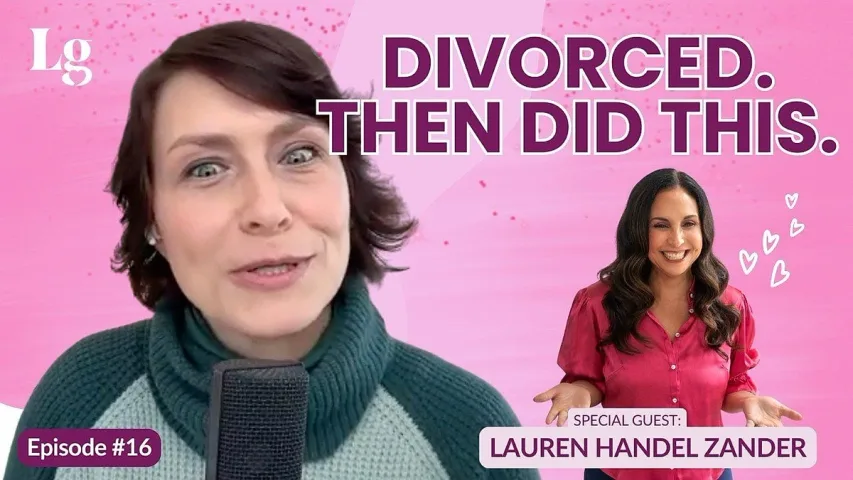
Watch the Episode: Finding Love After Divorce with Lauren Handel Zander
There is a moment in this episode that was surprising. Lauren tells the story of the exact moment she knew her "casual" situation had turned into something else entirely.
It involves an injury, a foreign country, a rainstorm, and a man who dropped everything to show up for her. It is one of the most powerful illustrations of what a healthy relationship actually feels like when it finally arrives.
There is also a reveal near the end of this episode that is likely to shock you. It has to do with who Lauren ended up with, and a specific detail about this person that most women over 50 would filter out before the first date ever happened.
That shift, from what we assume we need to what actually fits, changes everything about how you approach the dating game, how you recover from past mistakes, and how open you stay to the possibilities you are not even looking for.
You'll hear it explained fully in the episode here:

If you are dating over 50 and you want real tools for the dating scene, come to Laurie Gerber's free webinar, 3 Secrets to Finding and Maintaining Healthy Love: www.lauriegerber.com/webinar

Love,
Frequently Asked Questions about Post-Divorce Dating
How long should I wait before post-divorce dating?
There is no single right number, but most people benefit from at least a year to process the end of a previous marriage before pursuing a serious relationship. The healing process looks different for everyone. The key is making sure you are dating from curiosity and openness, not from fear or urgency.
Is online dating a good idea after 50?
Yes, and it is one of the most effective ways to meet new people in the current dating world. The best way to approach it is with a clear strategy: a strong dating profile, a defined sense of what you are looking for, and ruthless standards for who makes it past the first conversation.
What is the difference between casual fun and a committed relationship in dating?
Casual fun means you are open to enjoying someone's company without expectations of a long-term future. A committed relationship means you are actively evaluating for long-term compatibility. The problem is that most people re-entering the dating scene do not know which one they actually want, and that confusion creates a lot of pain.
What are the biggest red flags to watch for on a first date?
Showing up late or being dismissive of your time in any way. Talking primarily about a past relationship without any self-reflection. Inconsistency between what they say and what they actually do. And rushing toward a serious relationship before either of you actually knows the other person.
How do I know if someone is a good match for a long-term relationship?
The Head, Heart, and Hoo-ha framework is a useful starting point. Are you intellectually compatible? Do you feel emotionally cared for? Is the physical chemistry real? A good match scores at an 8 or above on all 3. Anything below a 6 in any category is worth pausing on before you agree to a second date.