The 3-Date Strategy: Key Signs He’s the Right Guy After 50
January 29, 2026
If you’re back in the dating world after 50, you already know what’s changed. There are more options, more confusion, more false starts, and more ways to lose time with someone who was never really right for you.
What I want for you instead is clarity. Not eventually. Not after weeks of texting. And definitely not after you’re already emotionally invested.
The 3-H (Head, Heart, and Hoo-Ha) chart is the most powerful tool I give my private clients because it helps them stop chasing potential and start choosing based on what’s actually happening.
This article shows you how to take that clarity into real dates so you can recognize the little things most women overlook.
Why the 3-H Chart Builds a Healthy Relationship Faster
Most women approach new relationships thinking they’ll figure things out as they go.
That approach sounds generous and open-hearted, but it often leads to the same kind of relationship repeating itself with a different person.
The 3-H chart acts as more than a checklist. It’s a compass. It keeps you aligned with your best interests when physical attraction, charm, and early excitement start clouding your judgment.
This is how a good relationship forms — by paying attention to what’s real for your head, your heart, and your hoo-ha, not just what feels good in the moment.
The 3-Date Strategy for New Relationships After 50
The rule is simple: you get three dates to decide whether someone is a maybe or a move on.
Not because you’re rigid. Because you’re intentional.
You’re no longer trying to spend endless time hoping something turns into real love. A meaningful relationship requires curiosity, attraction, and follow-through — and those show up early when they’re there.
Date One: Physical Attraction, Banter and Ruling Out Deal Breakers
The first date is about making a good first impression and assessing chemistry.
This is where physical attraction matters — it doesn't have to be sparks flying, but you have to enjoy being in each other’s presence. You’re paying attention to eye contact, body language, and whether the energy feels natural.
Ask yourself:
✅ Are you curious about each other?
✅ Is the banter easy and playful?
✅ Does spending time together feel good?
Chemistry alone does not create a successful relationship, but without it, there’s nothing to build on.
Your first date is also where you screen for obvious deal breakers using your Head criteria. Keep it playful, not interrogative.
Why Color-Coding the Small Things Changes Everything
After each date, you return to your 3-H chart and color-code what you learned.
✅ Green means yes
✅ Yellow means unclear
✅ Red means no
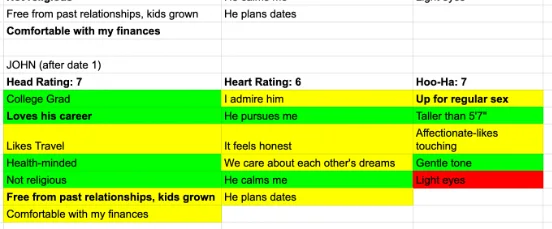
Those yellow areas become your focus for the next date. Reds — if they’re deal breakers — mean you stop, even if other things feel good.
This process trains you to notice the small things before they turn into big problems. It prevents you from explaining away red flags or talking yourself out of what your intuition already knows.
Date Two: Are Meaningful Connections Being Made?
Date two is where emotional alignment starts to show.
You’re noticing:
✅ Consistency — does he follow through?
✅ Ease — do you feel comfortable or anxious between interactions?
✅ Communication — does the rhythm actually work for you?
You’re also observing how he moves through the world.
✅ How does he treat people who can’t offer him anything?
✅ How does he handle minor frustrations?

Of course, you'll talk about common interests and any dealbreakers you have not hit upon that would ruin long-term potential. But the real purpose of Date 2 is to build emotional connection.
Choose settings that allow conversation and presence — a quiet meal, a walk, time to talk without distraction. You’re listening not just to his answers, but to how your body feels around him.
After the date, you color-code again and notice whether the greens are increasing, and what topics you're avoiding!
Date Three: Getting the Surefire Sign for Date 4
By the third date, you’re no longer collecting surface impressions.
You’re deciding.
By the end of date three, your Head, Heart, and Hoo-Ha should all be at least an eight out of ten. If you’re stuck at a six or seven, that’s information — not something to override.
Sometimes that means:
✅ You haven’t asked enough of the right questions
✅ You already know the answer, but don’t want to admit it yet
A successful relationship doesn’t require certainty about the future — but it does require clarity in the present.
The Four Common Signs He’s a Keeper
Across hundreds of clients, four indicators show up again and again.
✅ Consistency
He follows through. He communicates clearly. You’re not left wondering.
✅ Curiosity
He asks questions, listens to the answers, and shows interest beyond your physical appearance.
✅ Comfort
Your nervous system relaxes. You feel at ease being yourself.
✅ Compatibility
Overall, your 3-H chart stays mostly green. Not perfect — but mostly green.
These are key signs you’re moving toward the right kind of relationship.
Watch Episode 4: The 3-Date Strategy in Action
Watch this for further explanation:
Why Women Over 50 Take Fourth Dates They Shouldn't
Around date three, something predictable happens.
Your inner negotiator wakes up.
You start justifying red flags because there are also good things. You focus on one green area while minimizing another that feels uncomfortable.
That’s how women stay too long in the wrong relationship.
The 3-H chart keeps you honest. The three-date strategy keeps you moving.
Hear this clearly: being kind does not require ignoring the truth. You can be compassionate and still choose what protects your own life and future.
Coaching Homework: Make Your Chart Work in Real Life
Pull out your 3-H chart and make it usable.
✅ Put it into a Google Sheet or Excel file so you can reuse it
✅ After every date, color-code red, yellow, and green
✅ Rate Head, Heart, and Hoo-Ha from one to ten
Then ask yourself:
✅ Am I ignoring any part of myself to keep hope alive?
✅ What’s one truth I don’t want to admit yet?
Those questions alone can save you months — sometimes years.
Want Help Doing This Step by Step?
If you want me to walk you through this process with visuals, I invite you to watch my free class:
Three Secrets to Finding and Maintaining Healthy Love Without Repeated Disappointments.
You can watch it now at www.lauriegerber.com/webinar.

I’ll guide you through building the 3-H chart, using it on real dates, and dating smarter immediately — without losing yourself or settling.
Love does not have an expiration date. And you deserve a relationship that honors your whole self.
Love,

Frequently Asked Questions about the 3-Date Strategy
1. How do I know if he’s the right guy by date three?
You’re looking for alignment, not perfection. If your Head, Heart, and Hoo-Ha are all at an eight or above, no deal breakers have appeared, and his behavior is consistent, that’s a strong indicator you’re moving in the right direction.
2. What if there’s physical attraction but something feels off?
Physical attraction is important, but it’s not enough. If your body feels uneasy or your chart shows several yellow or red areas, that discomfort is information worth listening to.
3. What are the most important signs he wants a real relationship?
Consistency, curiosity, and follow-through are far more meaningful than words. A man who wants a meaningful relationship shows it through actions, not promises. Also, he's willing to wait to have sex.
4. How does body language factor into early dating decisions?
Body language often reveals more than conversation. Steady eye contact, relaxed posture, and natural engagement are small things that signal emotional availability and interest. But body language that signals a desire to move forward with the physical relationship before a lot of emotional rapport is built should be redirected.
5. Is it too harsh to stop dating someone after only three dates?
No. Ending early with clarity is kinder than staying out of confusion or worse, hope. The three-date strategy helps you respect both your own life and the other person’s time.